
Absheron Tour (Half day)
Absheron Tour
Absheron tour is a half-day guided private tour and covers the Fire Temple, Burning Mountain, Mardakan castle, and Heydar Aliyev Cultural center. The tour lasts about 3-4 hours and is ideal for travelers who have less time to discover the historical places of the city.
HIGHLIGHTS
Fire Temple (Ateshgah)
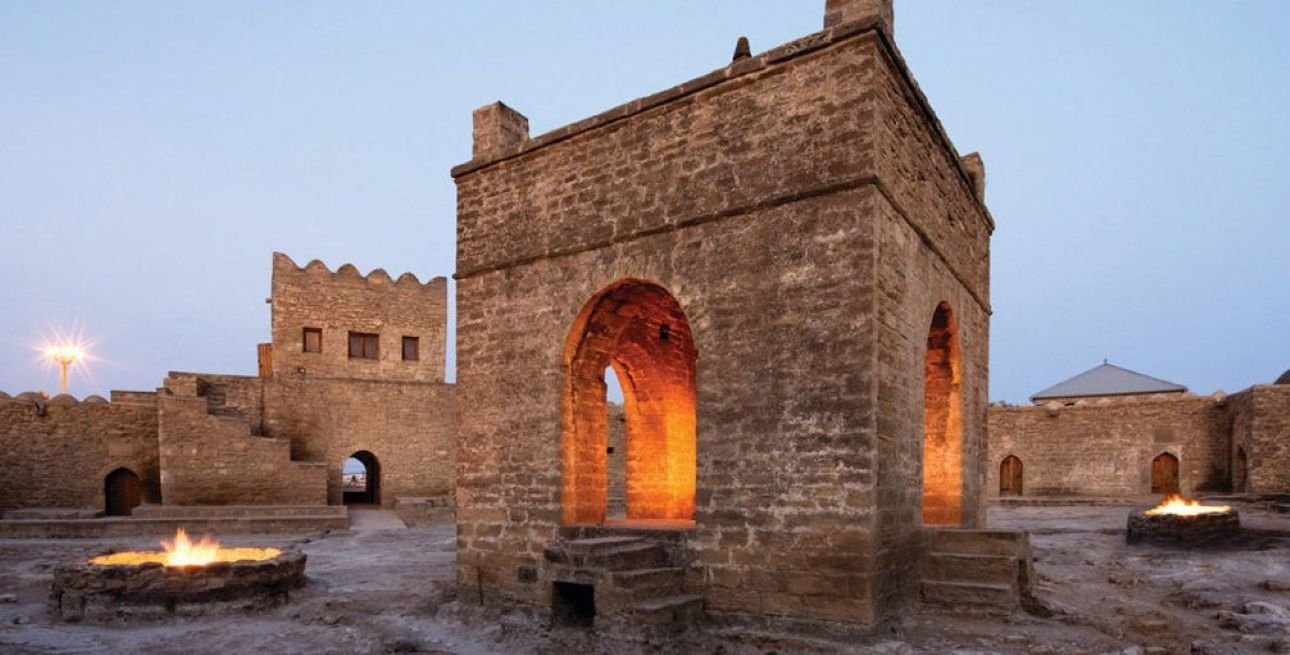
The first destination of the Absheron tour is the Baku Ateshgah (from Persian: آتشگاه, Atashgāh, Azerbaijani: Atəşgah), which is often called the “Fire Temple of Baku” is a castle-like religious temple in Surakhani town, a suburb in Baku, Azerbaijan.
Based on Persian inscriptions, the temple was used as a Hindu, Sikh, and Zoroastrian place of worship. “Atash” (آتش) is the Persian word for fire. The pentagonal complex, which has a courtyard surrounded by cells for monks and a tetrapillar-altar in the middle, was built during the 17th and 18th centuries. It was abandoned in the late 19th century, probably due to the dwindling of the Indian population in the area. The natural eternal flame went out in 1969, after nearly a century of exploitation of petroleum and gas in the area, but is now lit by gas piped from the nearby city.
Burning Mountain (Yanardagh)
Yanar Dag (Azerbaijani: Yanar Dağ, meaning “burning mountain”) is a natural gas fire that blazes continuously on a hillside on the Absheron Peninsula on the Caspian Sea near Baku. Unlike mud volcanoes, the Yanar Dag flame burns fairly steadily, as it involves a steady seep of gas from the subsurface. It is claimed that the Yanar Dag flame was only noted when accidentally lit by a shepherd in the 1950s.
Heydar Aliyev Cultural Center
The last destination of the Absheron tour will be the spectacular work of Zaha Hadid which is built in 2012 and covers 57,500 m2 area. Some facts about the building:
- The recorded cost of the center is 250 mln $.
- Architects did 2.5 years of research in order to just find out how to build this amazing building.
- The material that was used to make it outside of the center invented by the architects because there was no known material in order to make such a curved building.